
If your aquarium air pump is running but nothing bubbles in the tank, Fluval’s manual gives a short troubleshooting list. This guide follows that list and explains what each step means.

Quick answer: Check that the pump is plugged in. Check the airline and valves for blockages. If the accessories in the tank get no air, take the airline off the pump and see whether the pump itself produces air. If it doesn’t, the manual says the most common problem is a ripped or weakened diaphragm.
Safety first: Unplug or switch off all appliances in the aquarium before maintenance. Whenever you remove the pump from the air system, take the airline off the pump outlet before unplugging it, so water can’t siphon back into the pump.
This is based on the English section of Fluval’s A Series air pump manual (items A851, A853 and A854). Other pumps may differ, so check your own manual.
Step by step: what to check
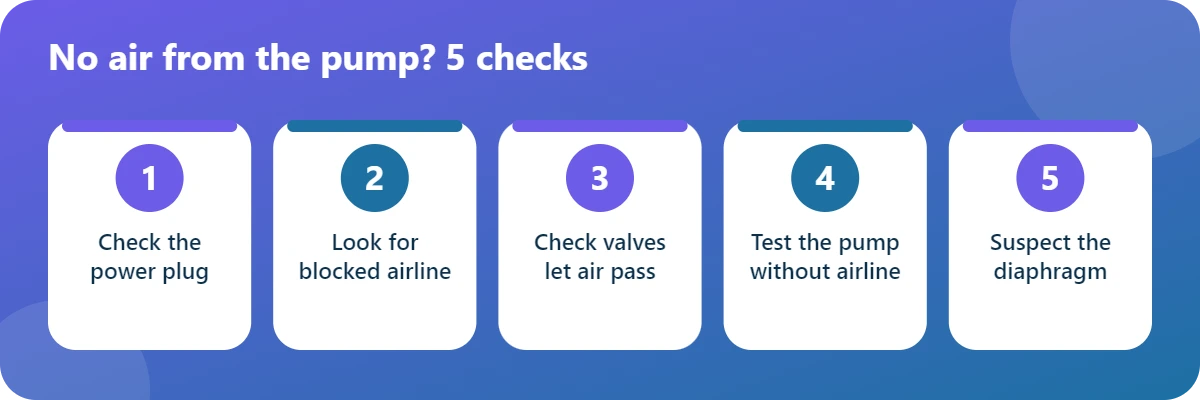
Step 1: Check the power
Make sure the air pump is plugged in.
Step 2: Check the airline and valves
Make sure there are no blockages in the airline assembly and that all valves let air through. The manual also says to make sure the airline has no restrictions or kinks.
Step 3: Test the pump without the airline
If the accessories in the tank (air stones, ornaments or a filter) produce no air, remove the airline from the pump and check whether the pump is producing air. Follow the manual’s rule for removing the airline: it should come off before the pump is unplugged. Using a check valve is highly recommended.
Step 4: Suspect the diaphragm
If the pump produces no output, the manual says the most common problem with any air pump is a ripped or weakened diaphragm.
Step 5: Contact the retailer or manufacturer
The manual says the pump needs no regular internal maintenance. If you have a problem, it says to contact Fluval or your retailer first, and to return a faulty pump to your retailer with proof of purchase and the reason for return. The guarantee is 2 years with proof of purchase and doesn’t cover wear and tear or parts that haven’t been maintained correctly.
Why a diaphragm fails
The manual explains that back pressure builds on the diaphragm when airflow is restricted. Over time, clogged air stones or other blockages and restrictions can make the diaphragm expand or rupture. An expanded diaphragm reduces the volume of air, and a ruptured one stops the air completely. See our guide to back pressure and flow control.
Quick reference
| What you see | What the manual suggests |
|---|---|
| No bubbles in the tank | Check the plug, the airline and the valves |
| Accessories get no air | Remove the airline from the pump and see if the pump makes air |
| Pump makes no air on its own | Most likely a ripped or weakened diaphragm |
Frequently asked questions
Why is my air pump running but no air comes out?
The manual says to check that it is plugged in and that the airline and valves aren’t blocked. If the pump still produces no air with the airline removed, the most likely cause is a ripped or weakened diaphragm.
How do I check the pump on its own?
Remove the airline from the pump outlet and see whether air comes out. Follow the manual’s rule to take the airline off before unplugging, and use a check valve.
Does the pump need regular internal maintenance?
No. The manual says it requires no regular internal maintenance. The rest of the air system should be checked and cleaned from time to time.
What causes a diaphragm to fail?
The manual says back pressure from clogged air stones or other blockages can make the diaphragm expand or rupture over time.
Is a failed pump covered by the guarantee?
Fluval’s guarantee is 2 years with proof of purchase. It does not cover wear and tear, or parts that haven’t been maintained correctly.
What this page doesn’t cover
This page covers air pump equipment only. It doesn’t give fish-health, medication or water-chemistry advice, and it doesn’t describe electrical repair.
Sources and last verified
- Fluval, A Series air pump instruction manual, EU edition with English section (official PDF): fluvalaquatics.com
Last verified: November 19, 2026, against the English sections of the PDFs listed above.