
If the bubbles from your air stone have weakened, the problem is often not the pump itself. Fluval’s manual explains why: restricted airflow builds back pressure on the diaphragm, and that is the thing to reduce.

Quick answer: Check the airline for kinks and the air stones for blockages. Set the flow control knob so airflow is not restricted. If you use a multi-outlet valve, leave one outlet open to release excess pressure. Keep the pump off carpet. If airflow stays weak, the diaphragm may be expanded or damaged.
Safety first: Unplug or switch off all appliances in the aquarium before maintenance. Take the airline off the pump outlet before unplugging the pump.
This is based on the English section of Fluval’s A Series air pump manual (items A851, A853 and A854). Other pumps may differ, so check your own manual.
What back pressure is
The manual defines back pressure as the build-up of pressure on the diaphragm caused by restricted airflow. It happens when the pump produces excess air, or when air channels are blocked by accident, for example by clogged air stones, airline or ornaments. Over time, back pressure can make the diaphragm expand or rupture. An expanded diaphragm leads to a loss of air volume, and a rupture means no air at all.
Step by step: what to check
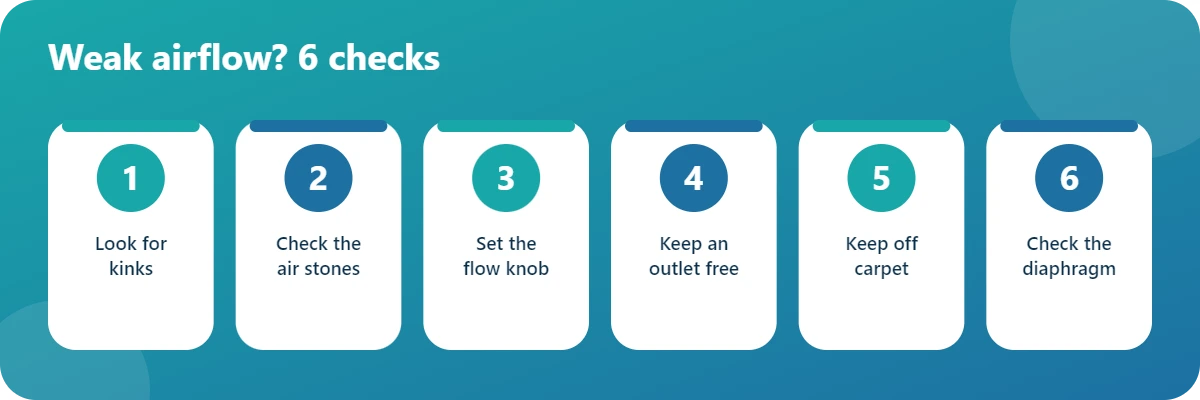
Step 1: Look for kinks and restrictions
Make sure the airline has no restrictions or kinks.
Step 2: Check the air stones and air system
The manual says the rest of the air system should be checked and cleaned from time to time. This helps keep back pressure down.
Step 3: Set the flow control knob
The A851 has one flow control knob, and the A853 and A854 have two. Turning the knob clockwise increases airflow and counter-clockwise reduces it. The ideal setting gives minimum back pressure, meaning airflow is not restricted. Correct airflow needs a balance between the valve setting and the pump’s output.
Step 4: Leave one outlet open on multi-outlet valves
If you use an air control valve with multiple outlets, always leave one outlet unused so excess pressure can bleed off. After adjusting, slowly open the last valve until you notice no loss of air from the items on the other valves. Note that if the first valve is fully open, air to the remaining outlets is reduced.
Step 5: Keep the pump off carpet
The manual says to place the pump somewhere dry and relatively dust-free, and not on carpet. Fibres can clog the pump’s air intake, which lowers air output, causes overheating and shortens the pump’s life.
Step 6: Consider the diaphragm
If airflow is weak and everything else is clear, the diaphragm may be expanded or weakened. See our guide to a pump that isn’t producing air.
Quick reference
| What you see | What the manual suggests |
|---|---|
| Weak bubbles | Check for kinks and blocked air stones, and set the flow knob |
| Several accessories on one valve | Leave an outlet open to bleed off pressure |
| Pump runs hot or air output is low | Check it isn’t on carpet and the intake isn’t clogged |
| Airflow falls over time | Back pressure may have expanded the diaphragm |
Frequently asked questions
What is back pressure in an air pump?
The manual defines it as pressure building on the diaphragm because airflow is restricted, for example by clogged air stones or blocked air channels.
Why has my airflow dropped over time?
The manual says long-term back pressure can make the diaphragm expand, which reduces air volume. It can also rupture, which stops the air.
Which way do I turn the flow knob?
Clockwise increases airflow and counter-clockwise reduces it. The ideal setting gives minimum back pressure.
Why leave a valve outlet open?
The manual says to keep an unused outlet on a multi-outlet valve so excess pressure can be released, which reduces back pressure.
Can I put the pump on a carpet?
The manual says no. Carpet fibres can clog the air intake, lower output, cause overheating and shorten the pump’s life.
What this page doesn’t cover
This page covers air pump equipment only. It doesn’t give fish-health, medication or water-chemistry advice, and it doesn’t describe electrical repair.
Sources and last verified
- Fluval, A Series air pump instruction manual, EU edition with English section (official PDF): fluvalaquatics.com
Last verified: November 19, 2026, against the English sections of the PDFs listed above.