
Aquarium equipment mixes water with mains electricity. Three manufacturer manuals (Eheim’s heater manual, Fluval’s AquaClear filter manual and Fluval’s A Series air pump manual) repeat the same core safety rules. This checklist pulls them together in one place.
Quick answer: Unplug everything before your hands go in the tank. Never use equipment with a damaged cord or plug, form a drip loop in every cord, don’t repair electrical parts yourself, and consider protecting the power supply with a residual current device (RCD or GFCI).
Safety first: If a plug or socket gets wet, don’t pull the plug. Switch off the fuse or circuit breaker that supplies the appliance first, then unplug it. See our wet plug guide.
This is based on three official manuals: Eheim’s heater manual, Fluval’s AquaClear AC Series filter manual and Fluval’s A Series air pump manual. Other brands and models may differ, so always check your own manual first.
The checklist
Before your hands go in the tank
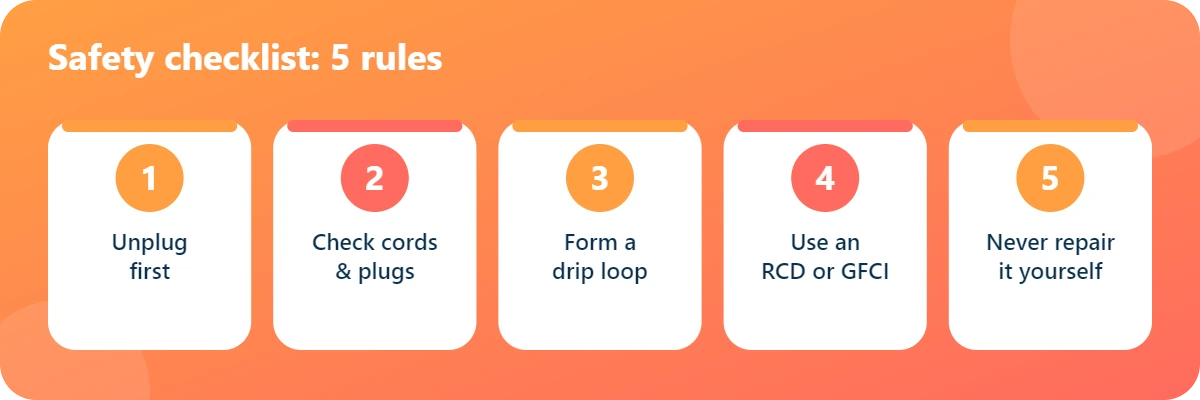
- Disconnect all electrical equipment in the aquarium from the mains before you put your hands in the water. Eheim’s US safety instructions say this directly, and Fluval’s filter manual says to unplug all appliances in the aquarium before placing hands in the water or taking parts off.
- Fluval’s air pump manual says to unplug or switch off all appliances in the aquarium or pond before maintenance.
- Never pull a plug out by the cord. Grasp the plug and pull.
Cords and plugs
- Don’t operate any appliance with a damaged cord or plug, one that is malfunctioning, or one that has been dropped or damaged. All three manuals say this.
- The cords on these appliances can’t be replaced. If a cord is damaged, the appliance must be scrapped. Fluval’s manuals add that you should never cut the cord.
- If you need an extension cord, use one with a proper rating. A cord rated for fewer amps or watts than the appliance may overheat. Arrange it so nobody can trip over or pull it.
Drip loops and sockets
- Form a drip loop in each cord: the part of the cord below the level of the socket (or the connector, if you use an extension cord), so water can’t run along the cord to the socket.
- Position the tank and stand to one side of a wall socket so water can’t drip onto the socket or plug.
- If a plug or socket does get wet, don’t unplug it. Switch off the fuse or circuit breaker first, then unplug and check the socket for water.
Water, heat and dry running
- Heaters: Eheim says the heater must be immersed at least to the MIN. WATER LEVEL marking and must never run out of water. It is very hot during and right after use, so never touch the heating zone.
- Filters: Fluval’s manual says never to operate the filter without water or let it run dry.
- Equipment that isn’t submersible (such as the AquaClear filter and Fluval air pump) must not be immersed. If it falls into the water, don’t reach for it. Unplug it first, then retrieve it.
RCDs, leaks and repairs
- Eheim recommends protecting all electrical aquarium appliances with a residual current protective device rated 30 mA or less.
- Fluval’s manuals say that if the appliance shows any sign of abnormal water leakage, or if the RCD or GFCI switches off, disconnect the power cord from the mains.
- Don’t try to repair damaged equipment yourself. The manuals say to return it to an authorized service facility or discard it.
Indoors and household use only
All three manuals say the equipment is for indoor household use. Don’t install or store it where it will be exposed to the weather or to freezing temperatures.
Quick reference
| Rule | What the manuals say |
|---|---|
| Unplug before hands in water | Eheim, Fluval filter and Fluval air pump all say to disconnect or switch off first |
| Damaged cord or plug | Don’t use it. The cord can’t be replaced, so the appliance is discarded |
| Wet plug or socket | Don’t unplug. Switch off the fuse or breaker first |
| RCD or GFCI | Eheim recommends 30 mA or less. The Fluval manuals say to disconnect if one trips |
| Repairs | Return to an authorized service facility or discard |
Frequently asked questions
Should I unplug equipment before a water change?
The manuals say to unplug or disconnect all electrical equipment in the aquarium before you put your hands in the water or take parts off.
What is a drip loop?
It is the part of the cord that hangs below the level of the socket (or the connector, if you use an extension cord), so water running along the cord drips off instead of reaching the socket.
Do I need an RCD or GFCI?
Eheim recommends protecting all electrical aquarium appliances with a residual current protective device rated 30 mA or less. The Fluval manuals say to disconnect the power cord if an RCD or GFCI switches off.
Can I repair equipment with a damaged cord?
No. The manuals say the cord can’t be replaced. If it is damaged, the appliance should be discarded, and Fluval’s manuals say never to cut the cord.
Are these rules the same for every brand?
Not necessarily. These rules come from three official manuals. Always follow the manual for your own equipment.
What this page doesn’t cover
This page covers equipment safety only. It doesn’t give fish-health, medication or water-chemistry advice, and it doesn’t describe electrical repair.
Sources and last verified
- Eheim, operating manual for the adjustable aquarium heater thermocontrole 25 to 400 (official PDF): eheim.com
- Fluval, AquaClear AC Series instruction manual, AC110 edition (official PDF): fluvalaquatics.com
- Fluval, A Series air pump instruction manual, EU edition with English section (official PDF): fluvalaquatics.com
Last verified: November 19, 2026, against the English sections of the PDFs listed above.